
The Signs That May Not Be Words
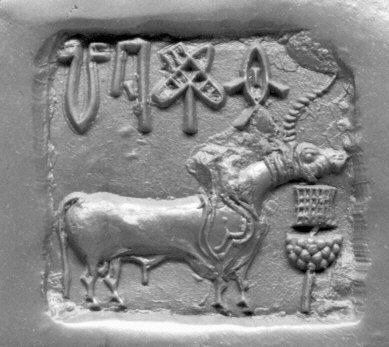
A small stone seal, two or three centimeters wide, carries a few signs and a picture of an animal. A thought arrives at once: this says something. KTT counts that thought as a thought, noticed or not, even when it arrives as a plain assumption that signs are words. For the Indus script, that assumption is exactly what is in dispute. The sources read for this article are encyclopedia entries, a computational study and a debate. They show that no one can read the script, and they disagree about whether it is writing.
What is there
The Indus, or Harappan, script comes from the Indus Valley civilization and dates to about 2600 to 1900 BCE. Thousands of inscribed objects have been found, mostly small stamp seals and their impressions, and also pottery, copper tablets and tools. In his 1977 concordance, Iravatham Mahadevan listed 417 distinct signs. Other scholars have counted 386 or 694. The average inscription is about five signs long. The longest runs only to some fifteen.
Why it cannot be read
Three things stand in the way. There is no known bilingual text, no Rosetta stone, to match the signs to a known language. The language behind the signs is itself unknown. And the inscriptions are very short, which gives almost no context for each sign.
Is it writing at all?
In 2004, Steve Farmer, Richard Sproat and Michael Witzel argued that the Indus signs are not writing in the sense of recording speech. They compared them with the symbols of clans, gods and families, like those on coats of arms. Other scholars disagreed. Massimo Vidale said their thesis was not acceptable on archaeological grounds, and Mahadevan called the “non-script” a non-issue. A computational study of the sign sequences reported evidence of a syntactic organization. These findings do not prove the script is a language, and they do not rule it out.
What this means for thoughts
If the signs are language, they might one day tell something about how people in the Indus cities spoke of thinking. If they are not, they will not. KTT cannot say which at present. No claim about Indus thought is supported by the sources read here.
What is not known
Whether the signs record a language is not known.
What the signs mean, if they mean anything, is not known.
Whether anything will ever be read depends on finding a longer text or a bilingual one. A claim of decipherment appears from time to time, and none is generally accepted.