
A City Built Before Writing
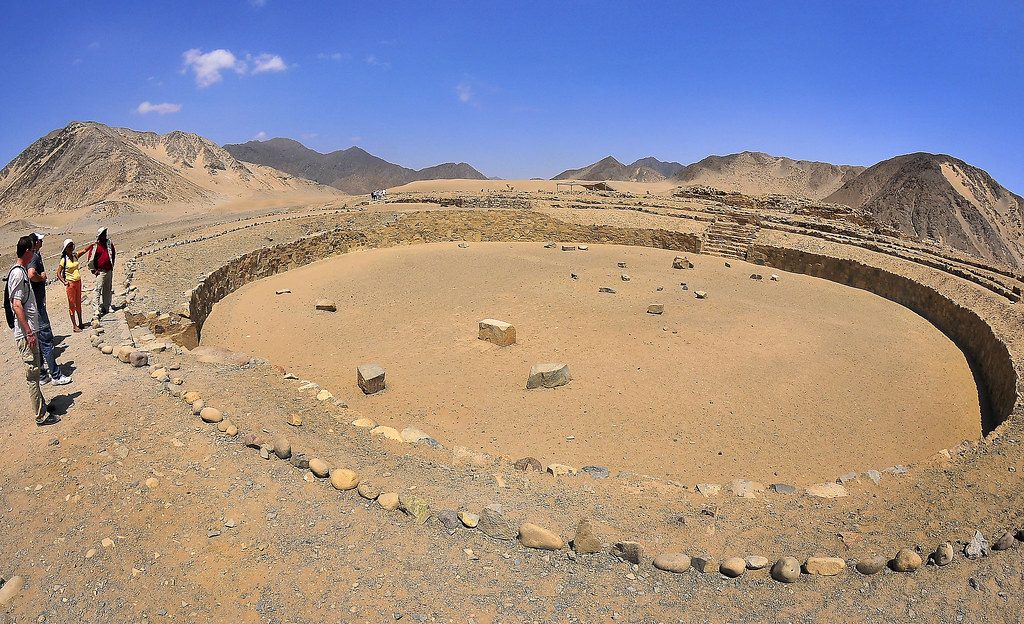
Coordinating a group project without a shared written plan tends to fall apart within days. Caral held together for roughly a thousand years, and the people who built it never wrote a word.
In the Supe Valley on the arid coast of Peru, construction began around 3000 BCE on a city that would eventually include six pyramid complexes, sunken circular plazas, and planned residential districts spread across 150 acres, home to an estimated several thousand people. It predates the Olmec civilization, the first complex society in Mesoamerica, by roughly fifteen hundred years. It was contemporary with early Mesopotamia and early Egypt, built on the opposite side of the world with no contact between them.
Caral's builders had no writing system. Early phases of the city also had no pottery, placing it in what archaeologists call the preceramic period, and no metal tools, no wheels. What they had instead was a coordinated irrigation system that redirected water across a desert landscape to grow squash, beans, and sweet potatoes, a fishing economy linked to a coastal settlement miles away, and pyramids oriented with enough precision to track the movement of celestial bodies.
None of that happens by accident, and none of it happens without a plan that many people held in common well enough to act on together. A canal has to be dug in the right sequence by people who are not digging the same stretch twice. A pyramid oriented to the stars requires someone to track the sky over time, and then communicate what they tracked to the people laying the foundation. Differences found between residential areas suggest some version of social rank existed too, meaning the plan itself was unevenly known: some residents likely held more of it than others.
This is not evidence of a theory of thought. No Caral text describes what its builders believed cognition to be, because no Caral text exists at all. What the city provides instead is a different kind of evidence, the kind cognitive archaeology increasingly treats as a legitimate source: thought inferred backward from what coordinated planning, sustained over generations, demonstrably required.
The gap is worth naming honestly. Caral's stones show that collective thinking happened. They do not show what its people called that thinking, or how they understood where it came from. The city answers one question and leaves the more interesting one, the one a written source might have answered, permanently open.